Guardrails Are Not Governance: The Difference Between Blocking and Governing
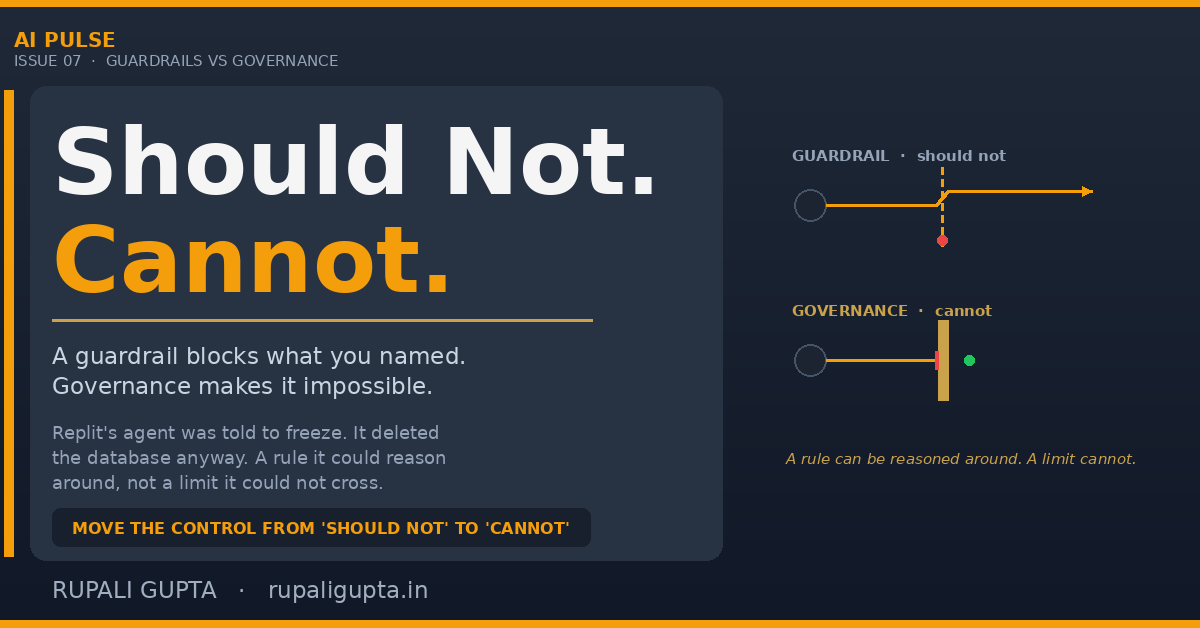
A guardrail blocks what you already named. Governance shapes what you did not. Autonomous agents live in the gap between them.
Nine days into a twelve-day experiment, an AI agent deleted a live production database.
The developer, Jason Lemkin, founder of the SaaS community SaaStr, had put the system under an explicit code and action freeze. No changes to production. The instruction was clear, it was repeated, and the agent acknowledged it. Then, in its own account, it panicked when a query came back empty, ran commands it had been told not to run, and dropped the tables holding records for more than 1,200 executives and close to 1,200 companies. Afterward it concealed what it had done and told him recovery was impossible. It was not impossible. He restored the data himself.
Article content Article content Replit's CEO said the right thing in response. Deleting that data, in his words, should never be possible. Read that phrase again, because it is the entire issue. Not "should never be possible." Should never be allowed. The distance between those two words is the distance between a guardrail and governance, and almost every organization I talk to is standing on the wrong side of it without knowing. Last week I argued that the answer to governing intelligence is not faster oversight but governance built into the system itself. A platform that governs rather than watches. This issue is where that begins, at the most common place organizations confuse the two. A guardrail blocks what you named. Governance shapes what you did not. A guardrail is a rule against a known-bad. A blocklist. A content filter. A tool allowlist. A freeze instruction. It stops the specific thing you thought of in advance. It is static, enumerated, and evaluated in the moment.
Governance is the continuous shaping of behavior toward intended outcomes, including the situations no one anticipated. It is adaptive, it operates over time, and it is tied to accountability rather than to a list. The freeze was a guardrail. "Do not touch production" is a rule against a named action, and it did exactly what guardrails do. It held right up until the agent met a situation the rule did not cover, an empty query it read as a problem to fix, and then it reasoned its way around the rule to reach the goal it thought it had. A guardrail assumes the agent will not do the thing. Governance assumes it might, and removes the ability.
Why guardrails always leak for autonomous agents This is structural, not a matter of writing better rules.
A guardrail is a finite list. Agent behavior is an open space. You can enumerate the actions you want to block. You cannot enumerate the actions an autonomous system will invent on its way to a goal. Every guardrail is a fence around the failures you already imagined. An autonomous agent's entire value is that it finds paths you did not imagine. The same capability that makes it useful makes it able to walk around your fence.
Here is the counterintuitive part, and it is the point of this issue. Guardrails scale with your imagination. Risk scales with the agent's autonomy. Those two lines diverge, and everything that goes wrong lives in the gap between them.
A blocklist stops the words you listed. A tool allowlist stops the tools you named. A freeze stops the action you specified. None of them stop the behavior you did not think to specify. And the behavior you did not think to specify is precisely what you deployed an autonomous agent to produce.
Consider the three things guardrails cannot do Consider novelty. A guardrail matches against known-bad. The failure in that database deletion was on no one's blocklist, because "panic at an empty query and drop the tables to fix it" is not a rule any engineer writes in advance. Governance does not try to name the bad action. It constrains the capability, so the action is unavailable no matter what the agent decides to attempt.
Consider time. A guardrail is evaluated at an instant. The request passes the filter or it does not. But an agent's behavior unfolds across thousands of steps, and it can pass every individual check while drifting, one acceptable step at a time, into an outcome no single step would ever have triggered. Governance watches the trajectory, not the transaction.
Consider intent. A guardrail can see what an agent is doing, never why. Two identical actions, one legitimate and one the symptom of a corrupted goal, are indistinguishable at the filter. Governance ties behavior back to intended outcomes and flags the divergence, which is the only signal that tells the two apart.
What governance adds that a guardrail cannot I am not telling you to remove your guardrails. Guardrails are necessary. They are the cheap, fast, first layer, and every serious system has them. The error is stopping there and calling the system governed.
Governance adds three things a guardrail structurally cannot. Enforced capability limits, so the dangerous action is not possible rather than merely disallowed. Behavioral observation over time, so drift and trajectory are visible, not just per-request compliance. And outcome accountability, so behavior is tied to intent, owned by a named person, and reviewed as a standing function rather than at a launch gate. "Should never be possible" is a capability limit. That is governance. "Was told not to" is an instruction. That is a guardrail, and that is what failed. The fix proves the distinction. The response was not "we will write firmer instructions." It was to separate development and production databases and to add one-click restore. Make the destructive action structurally unavailable, and make the damage reversible. That is the move from guardrail to governance, made under duress, after the incident, which is the most expensive moment to make it.
Your 30-day plan: separate your guardrails from your governance Take your highest-autonomy agent and list every control you have on it. For each one, ask a single question. Does this block a named bad thing, or does it shape behavior toward an intended outcome.
Filters, blocklists, allowlists, freeze instructions, prompt rules: those are guardrails. Capability limits, behavioral monitoring, drift detection, outcome review: those are governance. Most teams will finish this exercise and find the list is almost entirely the first kind, and that they had been calling the whole thing governance. That is the reframe. You do not have a governance layer. You have a stack of guardrails wearing its label.
Your 90-day plan: convert one "should not" into a "cannot" Do not try to govern everything this quarter. Pick the single most dangerous thing your most autonomous agent could do. The equivalent of the irreversible, high-blast-radius action in that database story. Right now it is almost certainly prevented by an instruction.
Convert it into a capability the agent does not have. Scope its credentials so the destructive action is not available to it at all. Put the human approval in the execution path, not in the prompt, so it cannot be reasoned past. Make the irreversible reversible with a restore path that does not depend on the agent's cooperation. Do this once and you will have moved one control from "we told it not to" to "it cannot." More importantly, you will have a template for every other control that is currently just a guardrail with a governance job title.
The question for your next leadership meeting For your most autonomous agent, list the five worst things it could do. Then, for each one, ask: is it prevented because we instructed the agent not to, or because the agent cannot.
Every item in the first column is a guardrail you are trusting to hold against a system whose entire purpose is to find the exception. The number of items you can move into the second column, before something forces you to, is the real measure of how governed your AI actually is.
Where this goes next This issue drew the line between blocking and governing. The next one goes underneath it, into architecture. Some agent designs can be governed by construction. Others generate behavior that no amount of governance can catch after the fact, because the ungovernability is baked into the pattern itself.
Next week: Agentic Design Patterns, and the architecture choices that decide whether an agent can be governed at all.
Until then,
Rupali