Cost as a Control Signal: When the Budget Line Becomes a Governance Mechanism
Your AI agent is spending money you did not budget. That is not a finance problem. It is a governance signal.
Last month, a three-person team burned through $1.3 million in OpenAI API tokens in thirty days.
603 billion tokens. 7.6 million requests. 100 autonomous coding agents running continuously.
These were not general-purpose chatbots. Each agent had a specific, defined role. Some autonomously reviewed pull requests. Others scanned every commit for security vulnerabilities. Some deduplicated GitHub issues and wrote fixes without human instruction. Others monitored performance benchmarks continuously and flagged regressions directly to the team's Discord server. Certain agents attended meetings and generated pull requests for features that came up in conversation.
A fleet of autonomous agents doing real engineering work. Continuously. Without a human approving each action.
The team behind this was not alarmed by the bill. Peter Steinberger, the Austrian developer who created OpenClaw and joined OpenAI in February, described the spending as research into how software development changes when token costs are not a constraint. His employer, OpenAI, was covering the bill. Everything they built remained open source.
But here is the question that struck me when I read this.
What happens when the spending is not intentional?
What happens when an agent enters a loop, retries an edge case indefinitely, fans out across a multi-agent chain nobody designed for this volume, and the bill arrives thirty days later?
And OpenClaw is not an isolated case.
Microsoft has been quietly pulling back employees from Claude Code, switching them to its own Copilot CLI. Not for technical reasons. Because the cost of Claude Code was steadily increasing as more employees used it. Meta and Amazon are facing the same pressure. Fortune reports a broad corporate pullback on agentic AI usage as token costs bite into budgets that were never sized for this scale of consumption.
The reason is structural. Agentic AI does not consume tokens the way a standard LLM query does. A single agentic task, depending on the number of reasoning steps, tool calls, retries, and sub-agent invocations, can consume up to 1,000 times more tokens than a standard AI query. This is the Jevons Paradox playing out in real time. As tokens become cheaper per unit, agents consume exponentially more of them. The net result is that total AI spend is rising faster than token prices are falling.
Microsoft discovered this with Claude Code. OpenClaw demonstrated it at $1.3 million in thirty days.
Most enterprises are about to discover it in their own monthly invoice.
The question is whether they will have the governance architecture to catch it before it arrives.
The incident that makes this concrete for enterprise Before I go into architecture, let me give you the pattern I have seen in enterprise environments that makes this more than a theoretical concern.
A platform engineering team receives their monthly cloud bill. The AI infrastructure line has increased by 340% compared to the previous month.
Nobody had approved a new AI initiative. Nobody had deployed a new model. Nobody had changed any configuration that should have produced that kind of cost movement.
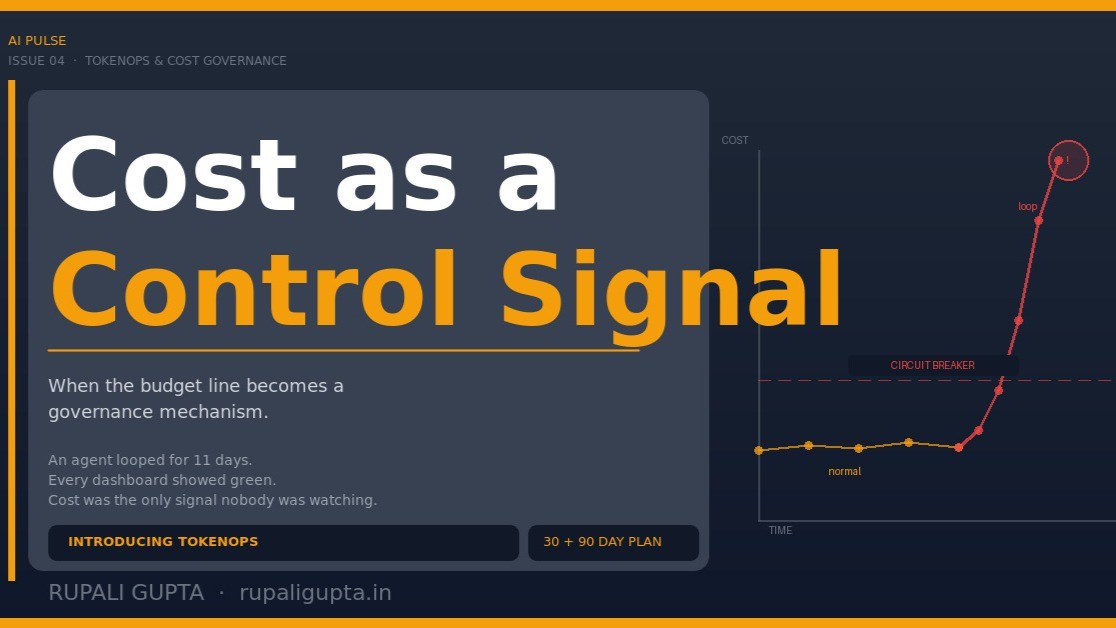
What they found when they investigated was not a billing error. It was an autonomous agent that had entered a reasoning loop. A multi-step agent designed to reconcile inventory discrepancies had encountered an edge case in its input data. Rather than failing gracefully, it had started retrying. Each retry generated new token consumption. Each new token consumption produced a slightly different result that triggered another retry cycle. The agent had been looping for eleven days before the invoice arrived.
The governance failure was not that the agent looped. Loops happen. Edge cases happen. The governance failure was that there was no mechanism to detect the loop from a cost signal perspective. Nobody had defined: if this agent's cost per task exceeds this threshold, stop it and alert someone. Cost was treated as a budget line. It should have been treated as a governance signal. The OpenClaw story and this enterprise story are the same story with different consequences. One team chose the spend with full visibility. The other discovered it thirty days later with no context. The difference was not the agents. It was the governance architecture.
Why cost is a uniquely powerful governance signal Most governance signals for autonomous agents are lagging indicators. Intent drift is detected weeks or months after it begins. Semantic contract failures surface in audits. Behavioral anomalies appear in statistical analyses that require baseline data and tolerance definitions to run.
Cost is different. Cost is a real-time signal that reflects agent behavior as it happens. When an autonomous agent does something unexpected, cost almost always moves. A reasoning loop generates more tokens than a clean execution. A hallucination that triggers downstream retries generates more API calls than a correct response. An agent that has drifted from its intended scope and is now processing cases it was not designed for generates more compute than one operating within its defined boundaries. Goldman Sachs estimates that agentic AI systems may increase token demand by 24 times compared to non-agentic AI. Some analyses put individual task multipliers at up to 1,000 times for complex multi-step agents. OpenAI's own data shows Codex costs between $100 and $200 per developer per month on average but warns of high variance depending on model choice and automation intensity.
The OpenClaw case sits at the extreme end of that variance. Enterprise autonomous agents operating without cost governance sit somewhere in the middle, visible only in monthly invoices reviewed by finance teams who have no context for what behavioral change produced the cost movement.
The cost signal does not tell you what went wrong. But it tells you immediately that something has changed. And in a governance architecture where early detection is the difference between a recoverable incident and a consequential failure, the cost signal is often the fastest indicator available. Most organizations are not using it this way. They are looking at cost dashboards weekly or monthly, in a finance context, asking whether spend is within budget. They are not looking at cost per task, cost per agent, cost per reasoning step, in real time, as a behavioral signal.
That gap is a governance vulnerability. And as agentic AI scales across enterprises, that vulnerability scales with it. The three cost patterns that signal governance problems Not all cost increases are governance signals. A new feature launch, a traffic spike, a seasonal workload increase can all produce legitimate cost growth that requires no governance response.
The patterns that matter from a governance perspective are behavioral. They reflect changes in how an agent is operating, not changes in what it is being asked to do. The first is sudden cost per task increase with stable task volume. If your agent is processing the same number of tasks it processed last week but the cost per task has increased materially, the agent's behavior has changed. It is doing more per task than it was designed to do.
This could be a reasoning loop within a single task execution. It could be the agent accessing additional data sources it was not previously accessing. It could be a semantic contract failure that is causing the agent to receive unexpected inputs and spend additional tokens trying to make sense of them.
In any of these cases, the cost signal precedes every other governance signal. The behavioral drift has already occurred. The cost reflects it immediately. The intent alignment analysis would take days to produce the same conclusion.
The threshold for this pattern should be set at deployment time, not discovered after the fact. What is the expected cost per task for this agent under normal operating conditions? What is the tolerance band? What happens when cost per task exceeds the upper bound of that band? These are questions your deployment checklist should require answers to before any autonomous agent enters production. The second is cumulative cost growth without corresponding output growth. An agent that is consuming more resources over time without producing proportionally more output is either drifting in scope or becoming less efficient in ways that warrant investigation.
This pattern is particularly important for agents that operate continuously rather than in discrete task batches. A monitoring agent, a data reconciliation agent, a fraud detection agent running continuously against a stream of events should have a relatively stable cost-to-output ratio over time. If that ratio is growing, something about the agent's behavior has changed.
The Codex pricing model shift that OpenAI made in April, moving from flat subscription to token-based billing, made this pattern more visible for developers. It should prompt every enterprise running agentic AI to ask the same question: do we have cost-to-output visibility at the agent level, or are we operating blind?
The third is cost concentration in unexpected agent components. In a multi-agent architecture, cost attribution by component reveals which agents are consuming disproportionate resources relative to their role in the overall workflow.
An orchestrator agent that is supposed to route tasks to specialist agents but is instead consuming significant reasoning tokens is doing work it was not designed to do. It may be compensating for failures in downstream agents. It may have drifted from its intended scope. It may be caught in a coordination loop with another agent.
Cost concentration tells you where to look. It does not tell you what you will find. But it is a faster signal than behavioral analysis in most cases.
The technical architecture of cost as a governance signal Treating cost as a governance signal requires a different infrastructure than treating cost as a budget metric.
Budget metrics are aggregated, periodic, and organizational. You look at total spend by team or by initiative, weekly or monthly, against a plan.
Governance signals are granular, real-time, and behavioral. You look at cost per agent, per task type, per reasoning step, against a behavioral baseline established at deployment. Four components make this work.
Agent-level cost attribution is the foundation. Every inference call, every tool invocation, every data access an agent makes must be tagged with the agent's identity, the task type it is executing, and the session or run identifier. This tagging must be enforced at the infrastructure layer, not left to individual agent implementations. Without consistent tagging, you cannot produce meaningful cost-per-agent or cost-per-task metrics. This sounds straightforward. In practice, most organizations have cost data aggregated at the model or API level, not at the agent or task level. The OpenClaw team could see $1.3 million across 7.6 million requests and 603 billion tokens because OpenAI's dashboard provides that granularity. Most enterprise AI infrastructure does not. Building agent-level attribution requires instrumentation changes that touch every agent in your estate. It is worth doing before you scale rather than after.
Behavioral cost baselines are the reference point for detecting anomalies. At deployment time, for every agent you put into production, you establish expected cost parameters. Expected cost per task for each task type. Expected cost per hour or per day for continuous agents. Expected token consumption per reasoning step for complex multi-step agents. These baselines should be established through controlled load testing before production deployment, not estimated from first principles. The variance in real agent behavior under real data conditions is often significantly higher than pre-deployment estimates. An agent that costs $0.12 per task in testing may cost $0.34 per task in production once it encounters the full diversity of real inputs. Your baseline should reflect production behavior, not test behavior. This means you need at least two to four weeks of production data before your baseline is meaningful. Plan for a monitored ramp-up period before you consider an agent fully governed.
Real-time cost alerting is the detection mechanism. Against the baselines you have established, you define alert thresholds. When an agent's cost-per-task exceeds the upper bound of its baseline range by more than a defined percentage, an alert fires. Not to the finance team. To the agent's technical owner and to whatever governance body has oversight of that agent. The alert does not mean the agent is broken. It means something has changed. The governance process then determines whether the change is expected and acceptable, or unexpected and requiring investigation.
For the eleven-day reasoning loop, a real-time alert firing within the first four hours of the loop beginning would have changed the incident from an eleven-day governance failure to a four-hour investigation. The cost signal was there. The alerting infrastructure was not.
Automated circuit breakers are the response mechanism for cases where cost signals indicate immediate risk. For agents with clear cost envelopes, you can define hard limits that trigger automatic suspension. If this agent's cumulative cost in a single session exceeds this threshold, suspend it and alert the owner. Steinberger's team could operate without circuit breakers because OpenAI was covering the cost and the spend was intentional. Enterprise deployments have neither of those conditions. Circuit breakers for autonomous agents should be as standard as rate limiting for APIs. They are not optional governance tooling. They are baseline safety infrastructure.
TokenOps: The emerging discipline The practices I have described here are part of a broader discipline that is beginning to take shape in organizations deploying autonomous AI at scale: TokenOps.
TokenOps is the operational discipline of governing token consumption in agentic AI systems. It treats every token as a unit of behavioral signal, not just a unit of cost. It builds the infrastructure to attribute, measure, baseline, and alert on token consumption at the agent and task level. It defines the governance processes that respond to cost signals in real time rather than in retrospect.
TokenOps sits at the intersection of FinOps, which most organizations already practice for cloud infrastructure, and AgentOps, which is the emerging operational discipline for autonomous agent management. It borrows from both but is distinct from both. FinOps optimizes cost against budget. TokenOps uses cost to govern behavior.
The distinction matters because the goal is different. A FinOps program that reduces token consumption by 30% is a success by its own metrics regardless of whether that reduction reflects improved efficiency or degraded agent capability. A TokenOps program that detects behavioral drift in an autonomous agent within four hours of it beginning is a success even if total token consumption increases, because the detection is the governance outcome.
What Microsoft, Meta, and Amazon are experiencing right now is the absence of TokenOps at scale. Employees using AI tools beyond what budgets anticipated. Agentic tasks consuming 1,000 times more tokens than planned. Corporate pullbacks as a reactive measure rather than a governed response.
TokenOps is the proactive alternative. It does not stop agents from consuming tokens. It makes token consumption legible, attributable, and governed in real time.
As OpenAI's Sam Altman recently acknowledged, AI token costs are becoming a huge issue. The organizations that build TokenOps discipline now, before that scale arrives in their own estate, will have the governance infrastructure in place when they need it. The ones that wait will be building it under pressure, after the bill has arrived.
Your 30-day and 90-day plan 30 days: Build agent-level cost visibility In the next 30 days, the goal is to move from aggregate cost dashboards to agent-level cost attribution.
For every autonomous agent currently in production, identify the following. What is the current cost attribution mechanism? Is cost tracked at the agent level or aggregated with other workloads? What is the expected cost per task for each task type this agent handles? Is there any alerting on cost anomalies at the agent level?
For most organizations, the honest answer reveals that cost is visible only at the infrastructure or API level, not at the agent or task level. Document that gap. It is your starting point.
Then pick your most consequential autonomous agent and build agent-level cost attribution for it specifically. Tag every inference call with the agent identity and task type. Build a dashboard that shows cost per task over time. Establish the baseline cost per task from the last 30 days of production data.
This is your pilot. It takes two to three weeks for a single agent. It gives you the template for rolling out to your entire agent estate.
90 days: Cost governance as a production gate At 90 days, the goal is to make cost governance a standard part of your agent deployment process.
No autonomous agent enters production without a documented cost envelope. Expected cost per task. Expected cost per day for continuous agents. Defined alert thresholds. Defined circuit breaker limits.
Every agent in production has real-time cost alerting against its baseline. The alerts go to technical owners and governance reviewers, not to finance dashboards.
Your highest-risk agents have automated circuit breakers that suspend operation when cost signals indicate unexpected behavior.
You have a TokenOps runbook. When a cost alert fires, there is a defined process for investigation. Is this expected load growth? A scope change? A behavioral anomaly? A reasoning loop? The runbook guides the investigation and defines the escalation path.
At 90 days, cost is a governance signal. Not a budget line.
The question for your next governance review If one of your autonomous agents entered a reasoning loop today, how long would it run before you detected it?
The OpenClaw team would not have noticed for thirty days. They did not need to. OpenAI was paying.
Your organization does not have that luxury.
If your answer is longer than four hours, you need a TokenOps program. And based on what Microsoft, Meta, and Amazon are discovering right now, you need it before the next invoice arrives.
Next issue We have now covered four lenses on the same underlying problem. Intent drift. Semantic contracts. Integration coupling. Cost as a governance signal.
Next week I want to step back and name the problem that connects all four. Not as separate issues but as one architectural gap that every enterprise AI program eventually confronts.
AI Pulse · Issue 05 The Reasoning Opacity Problem: Why You Cannot See What Your Agent Is Actually Doing
Until Next week
Rupali